Ankle Sprains Explained: Why Physical Therapy Matters for a Full Recovery

Why Proper Rehab Matters More Than You Think
Ankle sprains are one of the most frequent musculoskeletal injuries worldwide, yet many people underestimate their impact. While most sprains heal enough to walk again within days or weeks, research shows that up to 40% of people develop lingering instability or reinjury when rehabilitation is incomplete (1). Effective physical therapy doesn’t just reduce pain, it also restores strength, balance, and long-term joint stability.
Ankle Sprains are especially common in active individuals. Sports such as basketball, soccer, running, and volleyball have some of the highest rates. Overall court sports (basketball/volleyball have a rate of 7 ankle sprains per 1,000 athletic exposures (2). But even outside of sports, everyday activities like walking on uneven ground or missing a step can result in injury.
At Castine Concierge Physical Therapy in Washington, DC, we see ankle sprains of all types and severity levels. The right rehabilitation plan can determine whether you simply recover or regain lasting strength and stability.
Types of Ankle Sprains and What Gets Injured
An ankle sprain occurs when one or more ligaments, the strong bands of connective tissue that stabilize the joint, are stretched or torn.
There are three primary types:
Inversion (Lateral) Sprain – Most Common
Occurs when the foot rolls inward, stretching or tearing the lateral ligaments on the outside of the ankle—primarily the anterior talofibular ligament (ATFL) and sometimes the calcaneofibular ligament (CFL). This type represents up to 85% of all ankle sprains (3).Eversion (Medial) Sprain
Occurs when the foot rolls outward, placing excessive stress on the deltoid ligament located on the inside of the ankle. Although this type of sprain is less common than others, it is often more severe due to the strength and stability of the deltoid ligament, which typically requires greater force to injure.High Ankle (Syndesmotic) Sprain
Involves injury to the syndesmotic ligaments that connect the tibia and fibula just above the ankle joint. These injuries are more common in sports involving twisting or high-impact contact such as football, soccer, hockey or skiing (4).
Risk Factors for Ankle Sprains
Certain factors increase the likelihood of sustaining an ankle sprain, including:
Previous ankle injuries
Poor balance or proprioception
Weakness in ankle or foot stabilizers
Limited ankle dorsiflexion mobility
Inadequate or worn footwear
Uneven surfaces
Fatigue or reduced neuromuscular control
Addressing these risk factors are key to preventing recurrence and optimizing rehabilitation outcomes (5).
Clinical Presentation and Grading Severity
Common signs of an ankle sprain include:
Pain or tenderness around the affected ligaments
Swelling and bruising
Limited range of motion
Difficulty bearing weight
A feeling of instability or “giving way”
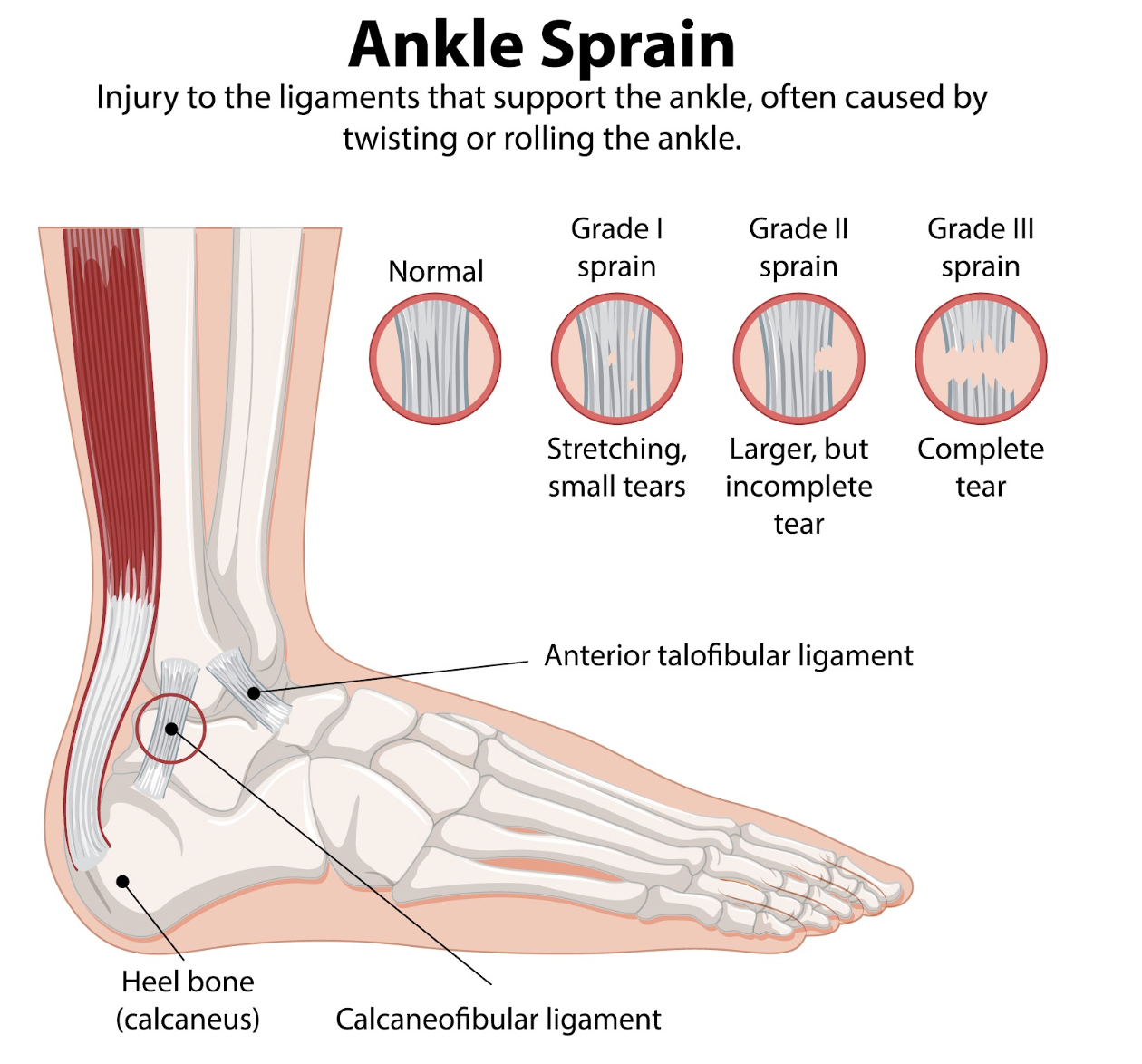
Sprains are classified by severity:
Grade I (Mild): Microscopic ligament stretching with mild tenderness and little instability.
Grade II (Moderate): Partial tear with noticeable swelling, bruising, and some instability.
Grade III (Severe): Complete ligamentous tear with significant swelling, bruising, and loss of joint instability.
Managing Ankle Sprains Through the Stages of Recovery
Rehabilitation should evolve with each stage of healing. At Castine Concierge PT, every plan is personalized to your phase of recovery and specific goals.
Acute Phase (First Few Days)
The goals are to protect the injury, manage pain, and control swelling.
Compression, elevation, and protected weight-bearing as tolerated
Gentle manual therapy to improve circulation and prevent stiffness
Early, guided movement to promote tissue healing (6).
Sub-Acute Phase (1-3 Weeks Post-Injury)
As inflammation decreases, focus shifts to restoring motion and muscle activation.
Strengthening for the peroneal and intrinsic foot muscles
Balance and proprioception training such as single-leg stance or wobble board exercises
Manual therapy to improve joint mobility and soft tissue flexibility
Chronic or Late Stage (3+ Weeks and Beyond)
This phase emphasizes regaining dynamic control and preparing for full activity or sport.
Agility and plyometric training to restore confidence in movement
Functional strengthening and progressive loading
Movement retraining to eliminate compensations and reduce reinjury risk
Our concierge approach allows us to guide you through each phase directly in your home or preferred setting, ensuring consistent progress and individualized care.
What Chronic Ankle Instability Can Lead To
Up to 40% of individuals may develop chronic ankle instability(CAI) following a first-time lateral ankle sprain, and inadequate or delayed rehabilitation has been associated with higher instability and recurrent sprains. CAI involves repeated episodes of “giving way,” weakness, or persistent discomfort (7).
If left untreated, it can contribute to:
Ongoing balance and coordination deficits
Reduced athletic performance
Degenerative joint changes and early osteoarthritis
Secondary issues in the knee, hip, or lower back due to compensation.
This underscores the importance of completing a structured rehab program that prioritizes balance, proprioception, and strength training.
Keys to Long-Term Success
Research consistently supports the following factors for optimal recovery and prevention of future injury:
Progressive and functional exercise rather than passive rest
Neuromuscular and balance training
Individualized programming tailored to the mechanism of injury
Consistency with a home exercise plan
Ongoing maintenance of ankle strength and mobility (8).
At Castine Concierge Physical Therapy, these evidence-based principles form the foundation of every treatment plan. Because we deliver care directly to you, we can provide real-time progressions and personalized feedback to help you recover faster and stay strong longer.
The Bottom Line
An ankle sprain doesn’t have to turn into a chronic issue. With the right plan and professional guidance, you can restore full function and confidence in your movement.
If you’re recovering from an ankle sprain or experiencing ongoing ankle instability in the Washington D.C. Area, Castine Concierge Physical Therapy can help. We bring expert, hands-on rehabilitation directly to your door so you can focus on healing efficiently without the stress of travel or waiting rooms.
Schedule your personalized in-home evaluation today and take the first step toward lasting recovery.
Written by: Stephanie Schultheis PT, DPT
References
Lin CI, Houtenbos S, Lu YH, Mayer F, Wippert PM. The epidemiology of chronic ankle instability with perceived ankle instability- a systematic review. J Foot Ankle Res. 2021 May 28;14(1):41. doi: 10.1186/s13047-021-00480-w. PMID: 34049565; PMCID: PMC8161930.
Doherty C, Delahunt E, Caulfield B, Hertel J, Ryan J, Bleakley C. The incidence and prevalence of ankle sprain injury: a systematic review and meta-analysis of prospective epidemiological studies. Sports Med. 2014 Jan;44(1):123-40. doi: 10.1007/s40279-013-0102-5. PMID: 24105612.
Ferran NA, Maffulli N. Epidemiology of sprains of the lateral ankle ligament complex. Foot Ankle Clin. 2006 Sep;11(3):659-62. doi: 10.1016/j.fcl.2006.07.002. PMID: 16971255.
Hunt KJ. Syndesmosis injuries. Curr Rev Musculoskelet Med. 2013 Dec;6(4):304-12. doi: 10.1007/s12178-013-9184-9. PMID: 23949902; PMCID: PMC4094093.
Delahunt E, Remus A. Risk Factors for Lateral Ankle Sprains and Chronic Ankle Instability. J Athl Train. 2019 Jun;54(6):611-616. doi: 10.4085/1062-6050-44-18. Epub 2019 Jun 4. PMID: 31161942; PMCID: PMC6602396.
Gaddi D, Mosca A, Piatti M, Munegato D, Catalano M, Di Lorenzo G, Turati M, Zanchi N, Piscitelli D, Chui K, Zatti G, Bigoni M. Acute Ankle Sprain Management: An Umbrella Review of Systematic Reviews. Front Med (Lausanne). 2022 Jul 7;9:868474. doi: 10.3389/fmed.2022.868474. PMID: 35872766; PMCID: PMC9301067.
Herzog MM, Kerr ZY, Marshall SW, Wikstrom EA. Epidemiology of Ankle Sprains and Chronic Ankle Instability. J Athl Train. 2019 Jun;54(6):603-610. doi: 10.4085/1062-6050-447-17. Epub 2019 May 28. PMID: 31135209; PMCID: PMC6602402.
Kaminski TW, Hertel J, Amendola N, Docherty CL, Dolan MG, Hopkins JT, Nussbaum E, Poppy W, Richie D; National Athletic Trainers' Association. National Athletic Trainers' Association position statement: conservative management and prevention of ankle sprains in athletes. J Athl Train. 2013 Jul-Aug;48(4):528-45. doi: 10.4085/1062-6050-48.4.02. PMID: 23855363; PMCID: PMC3718356.